Advent doors

A new door opens every morning from 1 to 24 December. Tap an open door to see its film and recipe.

Behind the doors

Every open door: one Christmas horror film and one Christmas recipe from history, oldest first.

9
Door 99 December
20
Door 2020 December
22
Door 2222 December

The Christmas recipes

Full recipes with ingredients, timed steps and the history behind each dish. They appear here as their doors open.

Small round Roman must cakes, golden brown, each baked on a bay leaf
Estimate: ~150 kcal per cake (12 cakes)

Mustacei: Roman Must Cakes

  • Prep20 min
  • Cook25 min
  • Makes12 cakes
  • Door1 December

1. Warm the spices: Heat the oven to 180 °C. Toast the anise and cumin seeds in a dry pan for 1 minute, until fragrant, then crush them roughly.
2. Make the dough: Rub the lard into the flour with your fingertips. Stir in the grated cheese, the crushed seeds and a pinch of salt.
3. Add the must: Pour in the grape must a little at a time and knead to a soft dough that no longer sticks. Cato says simply to sprinkle the flour with must.
4. Shape: Divide the dough into 12 balls and flatten each into a thick round cake about 6 cm wide.
5. Bake on bay leaves: Set each cake on a bay leaf on a baking tray, as Cato instructs, and bake for 25 minutes, until golden underneath.
6. Serve: Eat them warm. The bay leaf is not eaten: it perfumes the base of the cake as it bakes.

Mustacei, cakes from Cato's farm

History & Origins

This is the oldest recipe in the calendar. Around 160 BC the Roman statesman Cato the Elder wrote De Agri Cultura, a handbook for running a farm, and among its recipes is one for mustacei: wheat flour moistened with grape must, anise, cumin, lard and cheese, shaped into cakes and baked on bay leaves.

Mustacei were festive cakes, served at weddings and big family meals. Rome's great winter feast was Saturnalia in December, a week of gifts, banquets and role reversal that left traces in later Christmas customs. Must is fresh grape juice, still unfermented; unsweetened red grape juice is the closest you can buy today.

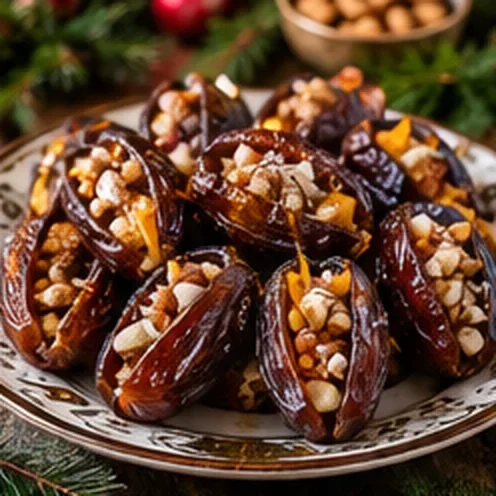
Glossy dates stuffed with walnuts and glazed in honey, sprinkled with black pepper
Estimate: ~260 kcal per serving (4 servings)

Dulcia Domestica: Roman Honey Dates

  • Prep15 min
  • Cook5 min
  • Makes4 servings
  • Door2 December

1. Stone the dates: Cut a slit along each date and take out the stone, keeping the date in one piece.
2. Stuff: Fill each date with a walnut half or a few pine nuts, and add a tiny pinch of ground black pepper, as Apicius suggests.
3. Salt the outside: Roll the stuffed dates very lightly in fine salt, just enough to touch the surface. It sharpens the sweetness.
4. Cook the honey: Warm the honey in a small frying pan over a medium heat for 2 minutes, until it bubbles and darkens slightly.
5. Fry in honey: Add the dates and roll them in the bubbling honey for 3 minutes, until glossy and sticky.
6. Serve: Lift them onto a plate, grind over a little more pepper and serve warm or cold.

Honey dates for Saturnalia

History & Origins

Dulcia domestica means “home-made sweets”. The recipe comes from Apicius, a Roman cookbook put together around the 4th or 5th century from much older recipes: remove the stones from dates, stuff them with nuts, pine kernels or ground pepper, salt the outside and fry them in cooked honey.

Sweets, dried figs and dates were classic Saturnalia gifts in December, sent to friends together with little clay figurines. Salt and pepper on a honey sweet may sound odd, but it is exactly what makes these addictive.

A clay cup of dark Roman spiced wine with honey, saffron, bay leaves and dates on the side
Estimate: ~170 kcal per glass (6 glasses)

Conditum Paradoxum: Roman Spiced Wine

  • Prep10 min
  • Cook15 min + 1 h to infuse
  • Makes6 glasses
  • Door3 December

1. Cook the honey with wine: Put the honey and 150 ml of the wine in a pan and bring to a gentle boil. Simmer for 5 minutes, skimming off the foam, as the Roman recipe says.
2. Add the spices: Add the crushed pepper, the saffron, the bay leaves and the chopped dates. Simmer for 5 minutes more.
3. Add the rest of the wine: Pour in the rest of the wine and warm it for 5 minutes, without letting it boil.
4. Infuse: Take the pan off the heat, cover and leave the spices to infuse for 1 hour.
5. Strain: Strain through a fine sieve lined with cloth or a coffee filter, until clear.
6. Serve: Serve warm in small cups, or chilled, as the Romans sometimes did.

The “surprising” spiced wine

History & Origins

Conditum paradoxum, “surprising spiced wine”, is the very first recipe in Apicius. Honey is boiled with a little wine, then flavoured with pepper, mastic, bay, saffron and roasted date stones, and finally mixed with a much larger amount of wine.

Honeyed, peppery wines like this were drunk at Roman banquets in winter, and they are the distant ancestor of mulled wine and hippocras, which comes two doors later in this calendar. Pepper is the “surprise”: it was an expensive import from India, and a sign of a rich host.

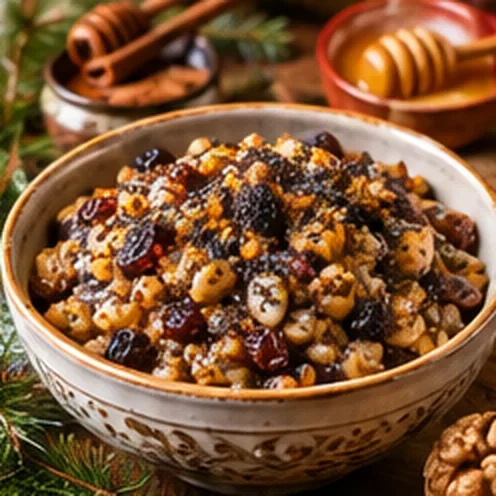
A bowl of kutia, whole wheat berries mixed with dark poppy seed, honey, walnuts and raisins
Estimate: ~330 kcal per serving (6 servings)

Kutia: Christmas Eve Wheat with Poppy and Honey

  • Prep20 min
  • Cook1 h 30 min + overnight soak
  • Makes6 servings
  • Door4 December

1. Soak the wheat: The night before, rinse the wheat berries and cover them with plenty of cold water. Leave them to soak overnight.
2. Cook the wheat: Drain, cover with fresh water and simmer for 1 hour 30 minutes, until tender but still chewy. Drain and leave to cool.
3. Prepare the poppy seed: Pour boiling water over the poppy seed and leave for 20 minutes. Drain well, then grind it in a mortar or blender until it turns milky and pale.
4. Soak the raisins: Pour hot water over the raisins for 10 minutes, then drain. Toast and chop the walnuts.
5. Mix: Warm the honey with 3 tbsp of hot water until runny. Stir the honey, ground poppy seed, raisins and walnuts into the wheat.
6. Serve: Serve at room temperature as the first dish of the Christmas Eve supper, when the first star appears.

Kutia, the oldest dish on the Christmas Eve table

History & Origins

Kutia is eaten on Christmas Eve across Ukraine, Belarus, Lithuania and eastern Poland, and at Orthodox Christmas in Russia. Whole wheat stands for life and harvest, poppy seed for abundance, and honey for a sweet year ahead. Everyone at the table must eat at least a spoonful.

The dish is probably much older than Christianity: boiled grain with honey was also a food for remembering the dead, and in many families a spoonful of kutia was traditionally left out for the ancestors on Christmas Eve.

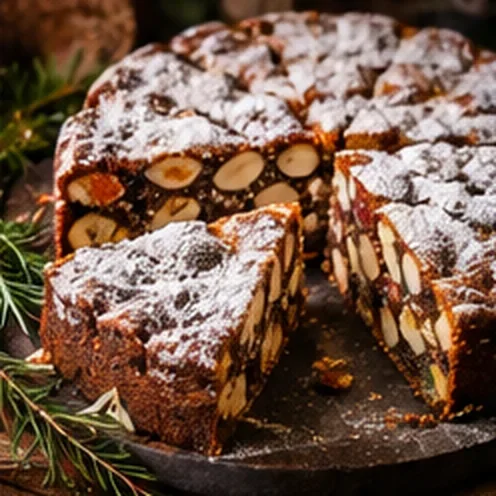
A round, dense panforte dusted with icing sugar, cut to show almonds, hazelnuts and candied peel
Estimate: ~230 kcal per slice (12 slices)

Panforte: Siena's Peppered Honey Cake

  • Prep25 min
  • Cook30 min + 2 h to cool
  • Makes12 slices
  • Door5 December

1. Toast the nuts: Heat the oven to 150 °C. Toast the almonds and hazelnuts on a tray for 10 minutes, then rub off the hazelnut skins.
2. Mix the dry ingredients: Line a 20 cm tin with rice paper or baking paper. Mix the nuts, chopped candied peel, flour, cinnamon, pepper, nutmeg and cloves in a big bowl.
3. Cook the syrup: Heat the honey and sugar in a pan, stirring, then boil for 3 minutes, until a drop forms a soft ball in cold water (about 115 °C).
4. Combine quickly: Pour the hot syrup over the nut mixture and stir fast: it stiffens quickly. Press it into the tin with a wet spoon.
5. Bake: Bake for 30 minutes. It will still look soft but firms up as it cools.
6. Cool and dust: Leave in the tin for 2 hours, then turn out and dust thickly with icing sugar. Cut into thin wedges.

Panforte, the “strong bread” of Siena

History & Origins

Panforte means “strong bread”, for its powerful spices. Its ancestor, a honey-and-pepper bread called panpepato, is often said to appear in a document from Siena in 1205, as a tax of honey and pepper bread owed to a convent. Spices from the East came into Siena on the pilgrim road to Rome, and the city's spice merchants turned them into this Christmas cake.

The white version dusted with icing sugar, called Panforte Margherita, is said to have been made in 1879 for Queen Margherita's visit to Siena. It keeps for weeks wrapped in paper, which is why it travelled well in medieval times.

A bowl of golden frumenty, creamy wheat cooked with milk and saffron, topped with currants
Estimate: ~290 kcal per serving (4 servings)

Frumenty: Medieval Christmas Wheat Pudding

  • Prep10 min
  • Cook35 min
  • Makes4 servings
  • Door6 December

1. Soak the saffron: Crumble the saffron into 2 tbsp of hot milk and leave it for 10 minutes to release its colour.
2. Cook the wheat: Simmer the cracked wheat in 300 ml water for 15 minutes, until it has soaked up the water.
3. Add the milk: Pour in the milk and simmer gently for 15 minutes more, stirring often, until thick and creamy.
4. Thicken with yolks: Take the pan off the heat. Beat the egg yolks with the saffron milk, stir in a ladle of the hot wheat, then stir everything back into the pan.
5. Finish: Warm for 2 minutes without boiling, then stir in the sugar, the salt and the currants.
6. Serve: Serve warm, on its own or next to roast venison, as at a medieval feast.

Frumenty, from the court of Richard II

History & Origins

Frumenty, from the Latin frumentum, “grain”, is in The Forme of Cury, written around 1390 by the master cooks of King Richard II of England: wheat pounded and boiled, then cooked with milk and egg yolks and coloured with saffron. At royal feasts it was served with venison or porpoise.

In the north of England, frumenty stayed a Christmas Eve tradition for centuries, eaten with cheese and Christmas cake. It is also the drink that sets off the story in Thomas Hardy's novel The Mayor of Casterbridge, laced with rum.

A glass goblet of dark red hippocras with cinnamon sticks, ginger, cloves and a cloth strainer
Estimate: ~160 kcal per glass (6 glasses)

Hippocras: Medieval Spiced Wine

  • Prep10 min
  • Cook10 min + 2 h to infuse
  • Makes6 glasses
  • Door7 December

1. Grind the spices: Lightly crush the cinnamon, ginger, cloves, grains of paradise and nutmeg in a mortar. Do not grind them to powder, or the wine will turn cloudy.
2. Warm the wine: Warm the wine with the sugar in a pan for 5 minutes, stirring until the sugar dissolves. Do not let it boil.
3. Add the spices: Take the pan off the heat and stir in the spices.
4. Infuse: Cover and leave to infuse for 2 hours. Taste: if you like it stronger, leave it longer.
5. Strain through a sleeve: Pour it through a cloth bag or a coffee filter until clear, exactly as medieval cooks did with their cone-shaped “Hippocrates' sleeve”.
6. Serve: Serve gently warmed, or cool, at the end of the meal with wafers or biscuits.

Hippocras, the wine at the end of the feast

History & Origins

Hippocras was the spiced, sweetened wine of the medieval and Tudor upper classes, served at the end of a great feast with wafers and sweet spices. The Forme of Cury, written for Richard II around 1390, gives a recipe, and French cookbooks of the same time have their own.

Its name comes from the cone-shaped cloth bag used to strain it, called a “Hippocrates' sleeve” after the Greek doctor, because apothecaries used the same filter for their medicines. Grains of paradise, a peppery seed from West Africa, were one of its key spices.

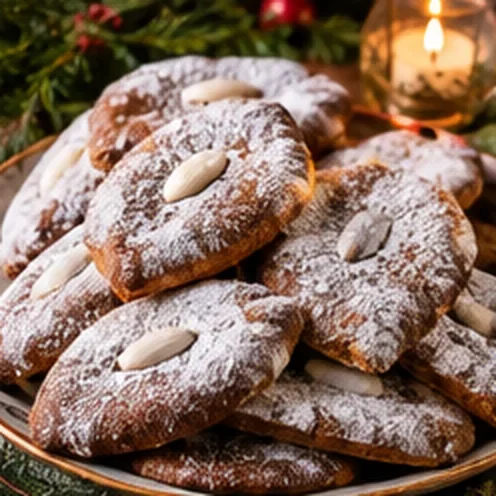
Round Nuremberg Lebkuchen on thin wafers, some glazed with chocolate and some with white sugar icing
Estimate: ~140 kcal per biscuit (20 biscuits)

Nuremberg Lebkuchen: Elisen Gingerbread

  • Prep30 min
  • Cook20 min + 1 h to dry
  • Makes20 biscuits
  • Door8 December

1. Whisk the eggs: Heat the oven to 160 °C. Whisk the eggs with the sugar and honey for 5 minutes, until pale and thick.
2. Fold in the nuts: Fold in the ground almonds and hazelnuts, the finely chopped candied peel, the lemon zest, the spice and the flour. The mixture should be thick and sticky.
3. Spread on wafers: Lay the round wafers on lined trays. Spread a heaped tablespoon of the mixture on each, doming it slightly and leaving a thin edge.
4. Dry: Leave the biscuits to dry at room temperature for 1 hour, so a thin skin forms. This stops them cracking.
5. Bake: Bake for 20 minutes, until just firm on top but still soft inside.
6. Glaze: While warm, brush half with melted dark chocolate and half with a thin icing of icing sugar and lemon juice. Keep in a tin for a week to soften.

The gingerbread bakers of Nuremberg

History & Origins

Lebkuchen are recorded in Nuremberg from 1395, and by the 15th century the city had its own guild of Lebküchner, gingerbread bakers. Nuremberg was on the great trade routes from Venice, so it had pepper, cinnamon and cloves, and the forests around it gave honey. Monks there were said to have baked Lebkuchen too.

The finest kind, Elisenlebkuchen, is made almost entirely of nuts, with very little or no flour, and baked on a thin wafer called an Oblate, a habit that comes from the communion wafers of the monasteries. Today “Nürnberger Lebkuchen” is a protected name in the EU.

A golden puff pastry galette des rois with a scored pattern, a paper crown beside it
Estimate: ~420 kcal per slice (8 slices)

Galette des Rois: The Kings' Cake

  • Prep25 min
  • Cook35 min + 30 min to chill
  • Makes8 slices
  • Door9 December

1. Make the frangipane: Beat the soft butter with the sugar until creamy, then beat in 1 egg, the ground almonds, the flour and the rum.
2. Assemble: Cut two 24 cm circles from the pastry. Lay one on a lined tray, spread the frangipane over it leaving a 2 cm border, and press the dried bean into the filling.
3. Seal: Brush the border with beaten egg, lay the second circle on top and press the edges firmly together.
4. Chill and decorate: Chill for 30 minutes. Brush with the rest of the beaten egg and score a pattern on top with the back of a knife. Make a small hole in the centre.
5. Bake: Bake at 200 °C for 35 minutes, until puffed and deep golden.
6. Serve the kings: Serve warm. The youngest person hides under the table and calls out who gets each slice. Whoever finds the bean is king or queen for the day and wears the paper crown.

Galette des rois and the bean king

History & Origins

The galette des rois is eaten in France for Epiphany on 6 January, the day the three kings reached Bethlehem, the end of the twelve days of Christmas. Choosing a “king” with a bean hidden in a cake is a medieval custom, and some historians link it to the Roman Saturnalia, when a mock king was chosen by lot.

The puff pastry and almond-cream version is the Paris style; in the south of France a brioche ring with candied fruit is eaten instead. Since the 19th century the dried bean, the fève, has often been replaced by small porcelain figures, and collecting them even has its own name: fabophilia.

A loaf of Dresden stollen thickly dusted with icing sugar, one slice cut to show raisins, peel and almonds
Estimate: ~330 kcal per slice (16 slices)

Dresden Christstollen

  • Prep40 min
  • Cook55 min + 2 h rising, + overnight soak
  • Makes16 slices
  • Door10 December

1. Soak the fruit: The night before, mix the raisins, candied peel and almonds with the rum. Cover and leave overnight.
2. Make the dough: Dissolve the yeast in the warm milk with 1 tsp sugar. Mix with the flour, the rest of the sugar, the egg, the soft butter, the salt, the zest and the spices, and knead for 10 minutes into a smooth, buttery dough.
3. Add the fruit: Knead the soaked fruit gently into the dough. Cover and leave to rise for 1 hour.
4. Shape: Roll the dough into an oval about 30 × 20 cm. Lay the marzipan roll down the middle if using, fold one long side over, not quite to the edge, and press down to make the classic stollen hump. Leave to rise on a lined tray for 1 hour.
5. Bake: Bake at 170 °C for 55 minutes, until deep golden. Cover with foil if the fruit on the surface starts to darken.
6. Butter and sugar: While still hot, brush with the melted butter again and again until it soaks in, then roll in caster sugar and cover thickly with icing sugar. Wrap and keep for 1 to 2 weeks before slicing.

Stollen, the bread that needed the Pope's permission

History & Origins

Stollen is first mentioned in Dresden in 1474, in an account of the city's Bartholomew hospital, as Christbrot, “Christ bread”. Its shape, a loaf folded over with a ridge down the middle, is said to look like the Christ child wrapped in swaddling clothes.

Early stollen was a poor thing, because during Advent, a time of fasting, butter was forbidden. The princes of Saxony asked Rome again and again for permission, and in 1490 Pope Innocent VIII finally sent the famous “butter letter” allowing it. Dresden still holds a Stollen festival with a giant loaf cut by a two-metre knife.

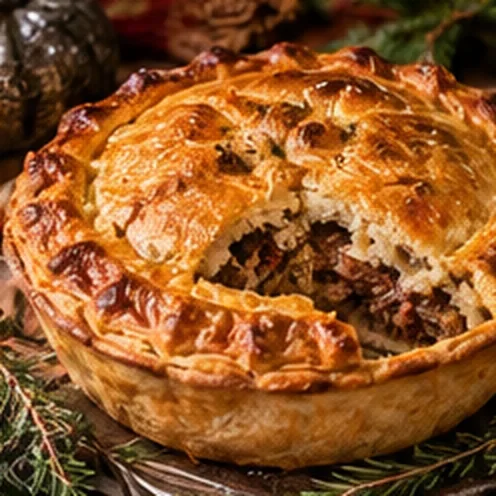
Small golden Tudor Christmas pies filled with spiced minced meat, currants and raisins
Estimate: ~310 kcal per pie (12 pies)

Tudor Christmas Pies: The First Mince Pies

  • Prep40 min
  • Cook35 min + 30 min to chill
  • Makes12 pies
  • Door11 December

1. Make the pastry: Rub the butter into the flour and salt until it looks like breadcrumbs, then add the egg yolk and enough cold water to make a firm dough. Wrap and chill for 30 minutes.
2. Brown the meat: Fry the minced meat in a dry pan for 5 minutes, breaking it up, until no longer pink. Leave to cool.
3. Mix the filling: Mix the meat with the suet, currants, raisins, chopped prunes, orange zest, sugar, mace, cloves, cinnamon, salt, pepper and the orange juice.
4. Fill the pies: Heat the oven to 190 °C. Roll out the pastry and line a 12-hole tin. Fill each case with the meat mixture and cover with a pastry lid, pressing the edges together.
5. Bake: Make a small hole in each lid, brush with milk and bake for 30 minutes, until golden.
6. Serve: Serve warm. In Tudor England a Christmas pie was eaten on each of the twelve days of Christmas for luck.

Christmas pies with real meat

History & Origins

Today's mince pies are sweet, but the Tudor “Christmas pie” or “shrid pie” was filled with shredded meat, usually mutton or beef, mixed with suet, dried fruit and the expensive spices brought home by the Crusaders. Sweet and savoury were not yet separated, and spices on meat showed off a family's wealth.

A popular story says the pies were baked oblong to look like the manger, and that Oliver Cromwell banned them. In fact the Puritan Parliament banned Christmas celebrations as a whole in 1647, not pies in particular. Over the 18th and 19th centuries the meat slowly disappeared, leaving only the suet as a reminder.

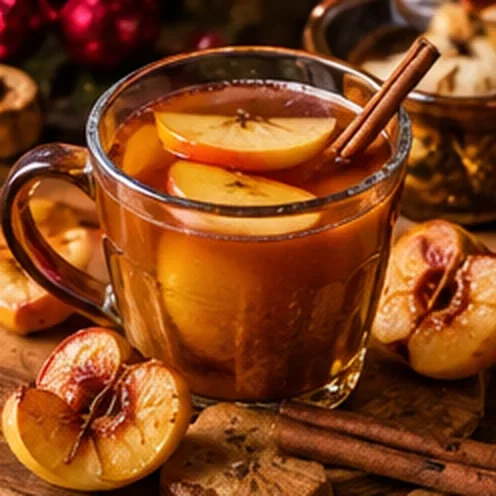
A wooden wassail bowl of hot spiced ale with fluffy roasted apple floating on top
Estimate: ~210 kcal per cup (6 cups)

Lambswool: The Wassail Bowl

  • Prep10 min
  • Cook45 min
  • Makes6 cups
  • Door12 December

1. Roast the apples: Heat the oven to 180 °C. Score the apples around the middle and roast them in a dish for 45 minutes, until they burst and are completely soft.
2. Warm the ale: Meanwhile, heat the ale with the sugar, nutmeg and ginger for 10 minutes, until steaming. Do not let it boil.
3. Make the wool: Scoop the soft apple flesh out of the skins, discarding cores and pips, and whisk it into the hot ale until it rises in a pale froth.
4. Taste: Add more sugar or spice to taste.
5. Serve: Pour into a big bowl or jug, with the fluffy apple floating on top like lamb's wool.
6. Wassail: Pass the bowl around and toast each other with “Wassail!” (“Be well!”), answered with “Drinkhail!”.

Lambswool and the wassail bowl

History & Origins

“Wassail” comes from the Old English wes hál, “be well”. On Twelfth Night, the end of Christmas, a large bowl of hot spiced ale was passed around and people went from house to house singing. In cider country, people also wassailed the apple trees, pouring ale on their roots to bless the next harvest.

The drink in the bowl was often lambswool: hot ale with roasted apples whose soft white pulp bursts out and floats on top like fleece. The poet Robert Herrick wrote about it in a Twelfth Night poem published in 1648: “Next crown the bowl full / With gentle lamb's wool”.

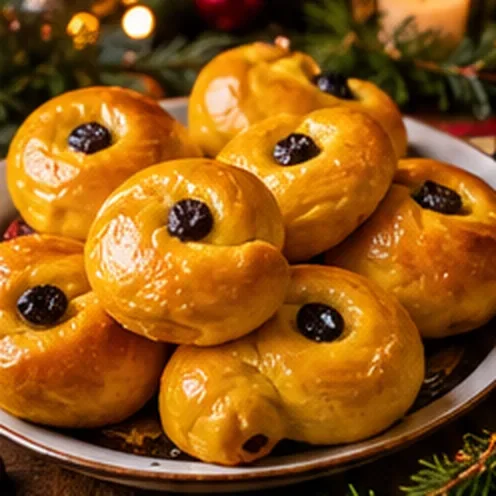
Golden S-shaped Swedish saffron buns with a raisin in each curl
Estimate: ~170 kcal per bun (20 buns)

Lussekatter: St Lucia Saffron Buns

  • Prep30 min
  • Cook10 min + 1 h 15 min rising
  • Makes20 buns
  • Door13 December

1. Bloom the saffron: Grind the saffron with 1 tsp of the sugar in a mortar. Warm the milk with the butter until the butter melts, then stir in the saffron and leave until lukewarm.
2. Make the dough: Mix the yeast into the warm saffron milk. Add the rest of the sugar, the quark, the salt and most of the flour, and knead for 10 minutes into a soft, smooth, bright yellow dough.
3. First rise: Cover and leave to rise in a warm place for 45 minutes, until doubled.
4. Shape the cats: Divide into 20 pieces. Roll each into a 20 cm rope and curl both ends in opposite directions to make an S. Press a raisin into the middle of each curl.
5. Second rise: Leave on lined trays to rise for 30 minutes. Brush with beaten egg.
6. Bake: Bake at 225 °C for 10 minutes, until golden. Cool under a cloth so they stay soft.

Lucia's cats

History & Origins

On 13 December Sweden celebrates St Lucia's Day. In the dark morning, a girl in a white dress with a crown of candles leads a procession singing and bringing coffee, ginger biscuits and lussekatter, “Lucia's cats”, saffron buns curled into an S with raisin eyes.

Under the old calendar, 13 December was the longest night of the year, and in folk belief evil spirits were loose. One story says the devil came as a cat and handed out buns to children, and Lucia's golden saffron buns were meant to keep him away. Saffron buns are mentioned in western Sweden from the 17th century; the modern Lucia procession spread in the early 1900s.

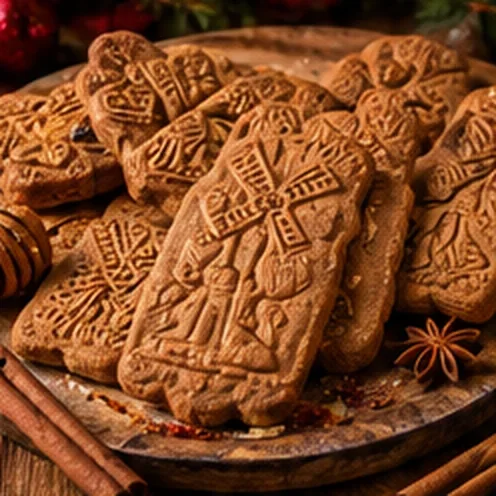
Thin brown speculaas biscuits pressed with windmill and figure patterns, with flaked almonds
Estimate: ~95 kcal per biscuit (30 biscuits)

Speculaas: Sinterklaas Spice Biscuits

  • Prep25 min
  • Cook18 min + 1 h to rest
  • Makes30 biscuits
  • Door14 December

1. Mix the spice: Mix the cinnamon, nutmeg, cloves, ginger, cardamom and white pepper. This is your speculaas spice; you need 2 heaped tablespoons.
2. Make the dough: Rub the butter into the flour, brown sugar, spice, baking powder and salt, then add the milk and knead briefly into a firm dough.
3. Rest: Wrap and leave the dough in the fridge for 1 hour, or overnight for a deeper flavour.
4. Shape: Heat the oven to 175 °C. Dust a wooden speculaas mould with flour, press the dough in firmly and knock the biscuit out onto a lined tray. Without a mould, roll the dough 5 mm thick and cut shapes.
5. Add almonds: Press a few flaked almonds onto the back of each biscuit.
6. Bake: Bake for 18 minutes, until darker at the edges. They crisp up as they cool.

Speculaas and Sinterklaas

History & Origins

In the Netherlands and Belgium, presents come on 5 December, the eve of St Nicholas, when Sinterklaas arrives. Speculaas, thin spiced biscuits pressed into carved wooden moulds, are part of the feast. The moulds show windmills, ships, animals and St Nicholas himself, and old ones are now collected like small works of art.

The name may come from the Latin speculum, “mirror”, because the biscuit is a mirror image of the mould, or from speculator, “one who watches over”, a title of the bishop. Spice biscuits like these became common in the 17th century, when the Dutch East India Company made the Netherlands the centre of the European spice trade.

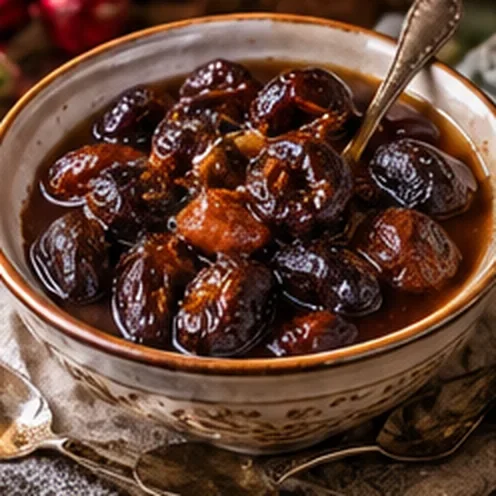
A bowl of dark plum pottage, a thick spiced beef broth with prunes, raisins and pieces of beef
Estimate: ~430 kcal per serving (6 servings)

Plum Pottage: Stuart Christmas Soup

  • Prep15 min
  • Cook2 h 30 min
  • Makes6 servings
  • Door15 December

1. Cook the beef: Put the beef in a large pot with the water and the bay leaves. Bring to the boil, skim, then simmer gently for 2 hours, until the meat is tender.
2. Add the fruit: Lift out the beef, cut it into small pieces and return it to the broth. Add the prunes, raisins and currants.
3. Thicken: Stir in the breadcrumbs, the wine, the sugar and the spices. Simmer for 30 minutes, stirring often, until thick enough to coat a spoon.
4. Season: Taste and add salt, more sugar or more spice. It should be both rich and gently sweet.
5. Rest: Take it off the heat and leave it for 10 minutes so the fruit plumps up.
6. Serve: Serve hot in deep bowls as the first course of the Christmas dinner, as the Stuarts did.

Plum pottage, the ancestor of Christmas pudding

History & Origins

In the 17th and 18th centuries, a rich English Christmas dinner began with plum pottage: beef broth thickened with breadcrumbs and full of prunes, raisins, currants, wine, sugar and spices. “Plum” then meant any dried fruit, and especially prunes and raisins.

Over time the pottage got thicker and thicker, the meat disappeared, and it was boiled in a cloth instead of a pot. That is how plum pottage became plum pudding, which you will find behind door 18 as Christmas pudding. Plum pottage was still served at the royal court until the 1800s.

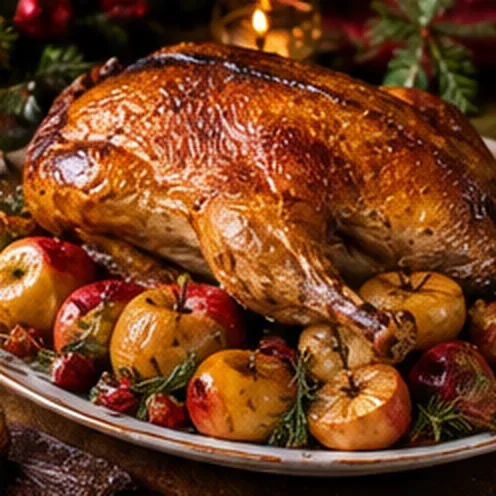
A golden roast goose on a platter, surrounded by baked apples and sprigs of marjoram
Estimate: ~720 kcal per serving (6 servings)

Roast Christmas Goose with Apples

  • Prep30 min
  • Cook3 h + 20 min to rest
  • Makes6 servings
  • Door16 December

1. Prepare the goose: Take the goose out of the fridge 1 hour before cooking. Pull out the loose fat from inside, prick the skin all over with a fork (not into the meat) and rub with salt, pepper and marjoram, inside and out.
2. Stuff: Heat the oven to 220 °C. Fill the goose with the quartered apples, the onion and a few sprigs of marjoram.
3. Start hot: Put the goose on a rack over a deep tray and roast for 20 minutes to start crisping the skin.
4. Roast slowly: Turn the oven down to 180 °C and roast for about 2 hours 40 minutes more (about 35 minutes per kg in total). Every 30 minutes, pour off the fat from the tray into a jar.
5. Rest: When the juices run clear, rest the goose under foil for 20 minutes. Bake the extra apples next to it for the last 30 minutes.
6. Serve: Carve and serve with the baked apples, red cabbage and potatoes roasted in the goose fat.

The Christmas goose

History & Origins

Before the turkey, the goose was the great Christmas bird of northern Europe. Geese were fattened on the stubble after the harvest and were at their best in late autumn and winter, which is why they were eaten on St Martin's Day in November and again at Christmas. In Germany, Denmark and Poland the Christmas goose with apples is still a tradition.

In Charles Dickens's A Christmas Carol (1843), the poor Cratchit family's Christmas dinner is a small goose, and Scrooge, changed, sends them a giant turkey: a sign of how the turkey was replacing the goose in Victorian England. Do not throw away the fat: it makes the best roast potatoes.

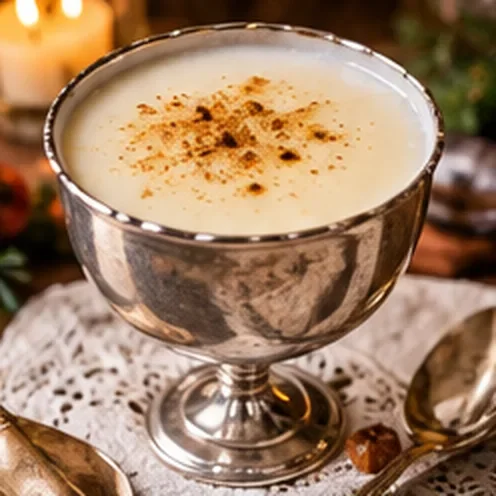
A pewter posset cup of hot spiced milk curdled with ale, dusted with nutmeg
Estimate: ~190 kcal per cup (4 cups)

Posset: Hot Milk and Ale

  • Prep5 min
  • Cook10 min + 10 min to set
  • Makes4 cups
  • Door17 December

1. Warm the ale: Warm the ale or sherry with the sugar and ginger in a small pan for 3 minutes, until the sugar dissolves. Pour it into a warm jug or bowl.
2. Heat the milk: Heat the milk (or milk and cream) until it just starts to rise, for about 5 minutes.
3. Pour from a height: Pour the hot milk into the ale from as high as you safely can. The splash makes the curd light.
4. Rest: Cover and leave in a warm place for 10 minutes, until a soft curd forms on top of the whey.
5. Spice: Grate plenty of nutmeg over the top.
6. Serve: Spoon the soft curd and drink the warm spiced whey underneath, ideally by the fire on a cold night.

Posset, the comfort drink of old England

History & Origins

Posset is one of the oldest English hot drinks, known since the 15th century: hot milk curdled with ale or wine, sweetened and spiced. It was drunk as a cure for colds, served to guests on winter nights and given to newly married couples at their wedding, and wealthy households had special spouted posset pots for it.

Shakespeare mentions it more than once: in Macbeth, Lady Macbeth drugs the guards' possets. Over the centuries the curd part turned into today's thick lemon posset dessert, but the old hot posset is the one for a Christmas night.

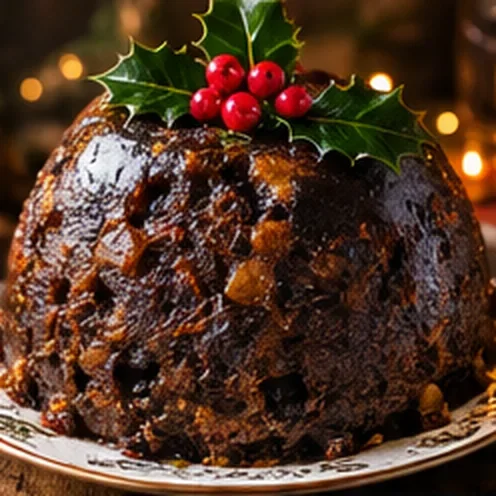
A dark round Christmas pudding topped with holly, with blue brandy flames around it
Estimate: ~520 kcal per serving (8 servings)

Eliza Acton's Christmas Pudding (1845)

  • Prep30 min
  • Cook3 h 30 min + 1 h to reheat on the day
  • Makes8 servings
  • Door18 December

1. Mix the dry ingredients: In a large bowl mix the flour, breadcrumbs, suet, raisins, currants, grated apple, sugar, chopped candied peel, spice and salt. Everyone in the house should stir and make a wish.
2. Add the eggs and brandy: Beat the eggs with the brandy and stir them in thoroughly. The mixture should drop easily from the spoon.
3. Fill the basin: Butter a 1.2 litre pudding basin, pack in the mixture and cover with a pleated sheet of baking paper and foil, tied tightly with string.
4. Steam: Stand the basin on a saucer in a large pot, pour in boiling water to halfway up its side, cover and simmer for 3 hours 30 minutes. Top up with boiling water now and then.
5. Store: Cool, re-cover with fresh paper and keep in a cool, dark place for up to 2 months.
6. Serve: On Christmas Day, steam for 1 hour, turn out, pour over 3 tbsp of warmed brandy, light it and carry it to the table in flames.

The first “Christmas pudding”

History & Origins

Plum pudding is much older, but the name “Christmas pudding” first appears in Eliza Acton's Modern Cookery for Private Families in 1845. Acton was one of the first cookbook writers to list exact quantities and cooking times for every recipe, and this is based on her own pudding, which she proudly called “The Author's Christmas Pudding”.

Tradition says it is made on “Stir-up Sunday”, the last Sunday before Advent, named after the church prayer that begins “Stir up, we beseech thee, O Lord”. Everyone stirs from east to west, for the journey of the three kings, and a silver coin is sometimes stirred in for luck.

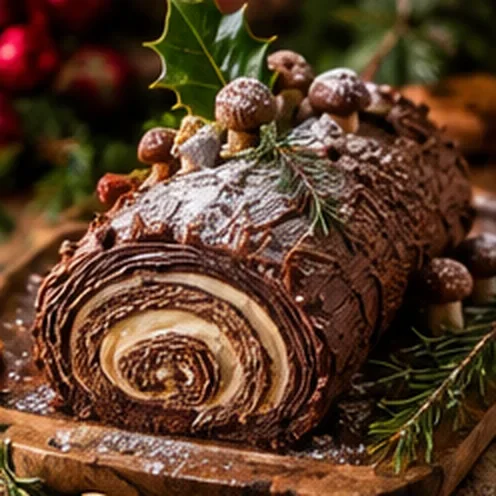
A chocolate Yule log cake with bark-like ganache, dusted with icing sugar snow and decorated with holly
Estimate: ~360 kcal per slice (10 slices)

Bûche de Noël: The Yule Log Cake

  • Prep40 min
  • Cook10 min + 1 h to chill
  • Makes10 slices
  • Door19 December

1. Whisk the sponge: Heat the oven to 200 °C and line a 30 × 40 cm tray. Whisk the eggs with the sugar for 8 minutes, until pale and thick enough to leave a trail.
2. Fold and bake: Sift in the flour and cocoa and fold in gently. Spread evenly on the tray and bake for 10 minutes, until springy.
3. Roll while warm: Turn the sponge out onto a sheet of baking paper dusted with sugar, peel off the lining and roll it up from the short side with the paper inside. Leave to cool rolled.
4. Make the ganache: Heat the 150 ml cream until it just boils, pour over the chopped chocolate, wait 2 minutes, then stir until smooth. Leave to thicken.
5. Fill and roll: Whip the 200 ml cream with the vanilla sugar. Unroll the sponge, spread with the cream and roll it up again without the paper.
6. Make the bark: Cut a short piece off one end and stick it on the side as a branch. Cover everything with the ganache, draw bark lines with a fork, chill for 1 hour and dust with icing sugar “snow”.

From the Yule log on the fire to the log on the plate

History & Origins

For centuries families in France and much of Europe burned a great log on the hearth over Christmas, the Yule log. It was chosen with care, sometimes blessed or sprinkled with wine, and its ashes were kept to protect the house from lightning and illness through the coming year.

As big open fireplaces gave way to iron stoves in the 19th century, the log moved from the fire to the table: Parisian pastry cooks began making a rolled sponge cake decorated as a log. It is now the classic French Christmas dessert, and every pâtisserie competes to make the most beautiful one.

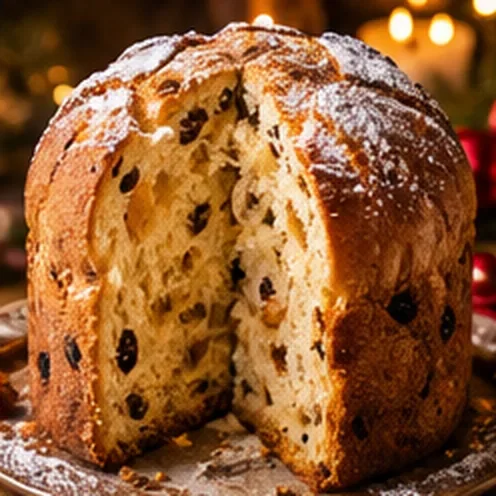
A tall domed panettone with a dark golden top, one slice cut to show the soft crumb with raisins and candied orange
Estimate: ~360 kcal per slice (12 slices)

Panettone: Milan's Christmas Bread

  • Prep45 min
  • Cook50 min + 4 h rising
  • Makes12 slices
  • Door20 December

1. First dough: Mix 150 g of the flour with the yeast and the warm milk. Cover and leave for 1 hour, until bubbly.
2. Main dough: Add the rest of the flour, the sugar, the eggs and yolks, the honey, the vanilla, the zests and the salt. Knead for 10 minutes, then knead in the soft butter a little at a time until the dough is glossy and very elastic.
3. Add the fruit: Knead in the raisins and candied orange. Shape into a ball and drop it into a tall 18 cm paper panettone mould.
4. Long rise: Cover and leave in a warm place for 3 hours, until the dough reaches almost to the top of the mould.
5. Bake: Cut a cross on top, put a knob of butter in the middle and bake at 180 °C for 50 minutes. Cover with foil if it darkens too fast.
6. Hang upside down: Straight out of the oven, push two long skewers through the base and hang the panettone upside down between two chairs or tall pans until cold, so the light crumb does not collapse.

Toni's bread and the Milan bakers

History & Origins

The best-known legend says panettone was born at the 15th-century court of Ludovico il Moro in Milan: the cook burned the Christmas cake, and a kitchen boy called Toni saved the day with a sweet bread made from his own leftover dough, “pan de Toni”. It is a lovely story, but there is no evidence for it.

What is certain is that sweet Christmas breads were baked in Milan for centuries, and that the tall domed panettone we know today was created in the 20th century by Milanese bakers. In 1919 Angelo Motta gave it its height by letting the dough rise three times in a tall paper collar, and factories made it famous around the world.

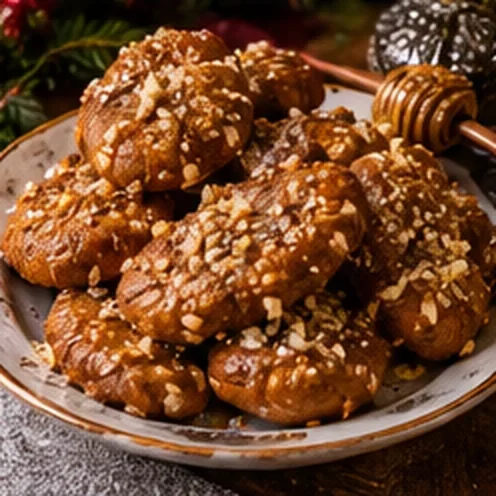
Oval Greek melomakarona soaked in honey syrup and covered with chopped walnuts
Estimate: ~150 kcal per biscuit (36 biscuits)

Melomakarona: Greek Honey Christmas Biscuits

  • Prep40 min
  • Cook25 min
  • Makes36 biscuits
  • Door21 December

1. Make the syrup first: Boil the honey, sugar, water, cinnamon stick and orange peel for 5 minutes, then take off the heat and leave to cool completely.
2. Mix the wet ingredients: Heat the oven to 180 °C. Whisk the olive oil, orange juice, sugar, zest and brandy together, then stir in the bicarbonate of soda.
3. Make the dough: Mix the semolina, flour, baking powder, cinnamon and cloves, and stir them into the oil mixture until you have a soft, oily dough. Do not knead it.
4. Shape: Roll walnut-sized pieces into ovals, press the top lightly with a fork and set them on lined trays.
5. Bake: Bake for 25 minutes, until deep golden.
6. Soak and finish: Drop the hot biscuits into the cold syrup for 30 seconds each, lift them out and sprinkle generously with chopped walnuts and a little cinnamon.

Melomakarona and the Greek Christmas

History & Origins

No Greek Christmas is complete without melomakarona, soft spiced biscuits made with olive oil and orange, soaked in honey syrup and covered in walnuts. They are made without butter or eggs, so they fit the Orthodox fast before Christmas, which lasts 40 days.

The name joins meli, “honey”, with makaria, a word linked to a Byzantine bread served at funeral meals for the dead, the same root as the Italian “macaroni”. Over the centuries the funeral bread became a sweet for the happiest feast of the year.

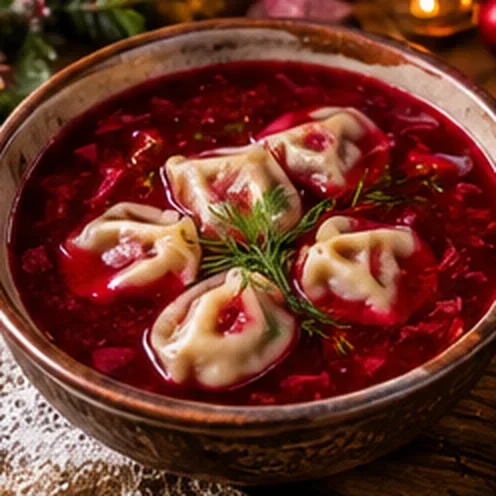
A clear ruby-red beetroot soup in a white bowl with tiny mushroom dumplings shaped like little ears
Estimate: ~230 kcal per serving (6 servings)

Barszcz with Uszka: Polish Christmas Eve Beet Soup

  • Prep1 h
  • Cook1 h + 30 min to soak the mushrooms
  • Makes6 servings
  • Door22 December

1. Soak the mushrooms: Soak the dried mushrooms in 500 ml hot water for 30 minutes. Lift them out, chop finely and keep the soaking water.
2. Make the broth: Peel and slice the beetroots. Simmer them with the carrot, parsley root, onion, garlic, bay leaves, allspice and the mushroom water (poured carefully, leaving any grit behind) plus 1.5 litres of water for 45 minutes.
3. Make the filling: Fry the chopped onion in butter for 8 minutes, add the chopped mushrooms and fry for 5 minutes more. Season and mix with the breadcrumbs.
4. Make the uszka: Knead the flour, egg, salt and warm water into a soft dough and roll it thin. Cut 4 cm squares, put a little filling on each, fold into a triangle and pinch the two corners together into a little ear.
5. Cook the uszka: Boil the uszka in salted water for 4 minutes after they float.
6. Finish the soup: Strain the broth, season with salt, sugar and lemon juice until sweet-sour and clear red, and serve hot with a few uszka in each bowl.

Wigilia and the little ears

History & Origins

In Poland, Christmas Eve, Wigilia, begins when the first star appears. The supper has no meat and traditionally twelve dishes, one for each apostle, an extra place is laid for an unexpected guest, and the meal begins with sharing a thin wafer. Clear red barszcz with uszka, “little ears” filled with forest mushrooms, is usually the first course.

Barszcz started as a soup made from the hogweed plant (barszcz in Polish) and only later became a beetroot soup. Traditionally it is soured with a fermented beet starter made a week in advance; lemon juice is the quick modern shortcut.

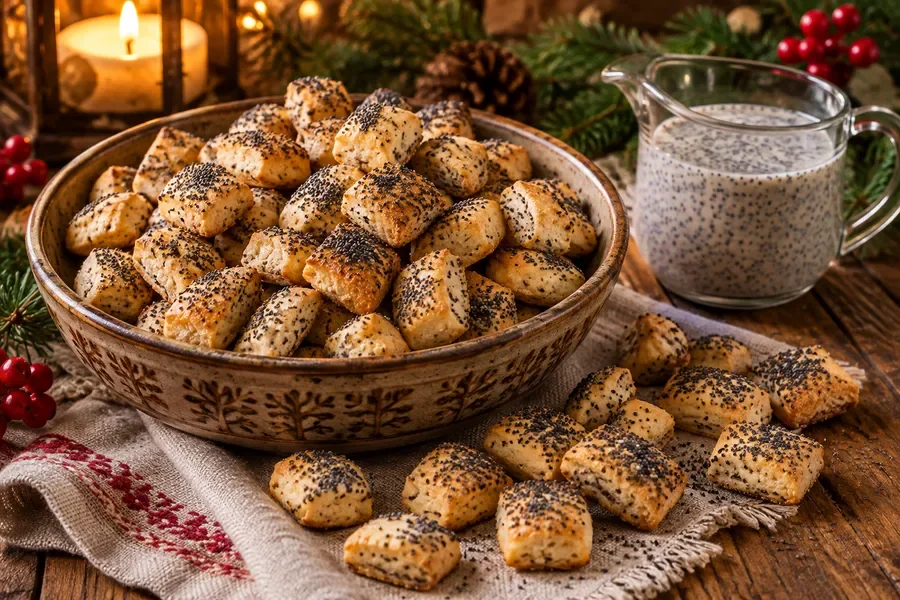
A bowl of small golden Lithuanian kūčiukai biscuits with poppy seeds, next to a jug of poppy milk
Estimate: ~380 kcal per serving (6 servings)

Kūčiukai with Poppy Milk

  • Prep30 min
  • Cook15 min + 1 h rising
  • Makes6 servings
  • Door23 December

1. Make the dough: Dissolve the yeast and sugar in the warm water. Mix with the flour, salt, oil and poppy seeds, and knead for 5 minutes into a smooth dough.
2. Rise: Cover and leave in a warm place for 1 hour, until doubled.
3. Cut the kūčiukai: Heat the oven to 200 °C. Roll the dough into thin ropes as thick as a finger and cut them into 1.5 cm pieces. Spread them on lined trays.
4. Bake: Bake for 15 minutes, shaking the trays once, until golden and crisp. Leave to cool.
5. Make the poppy milk: Pour boiling water over the poppy seed for the milk and leave for 10 minutes. Drain, grind in a blender with 500 ml cold water until milky, strain through a fine sieve and sweeten with honey.
6. Serve: Put the kūčiukai in bowls and pour the poppy milk over them just before eating, or serve them side by side to dip.

Kūčios, the Lithuanian Christmas Eve

History & Origins

Lithuanians call Christmas Eve Kūčios, and its supper has twelve meatless dishes. Kūčiukai, small crunchy yeast biscuits with poppy seed, are a must, eaten soaked in sweet poppy-seed milk. Hay is spread under the tablecloth to remember the manger, and a place is often left empty for family members who died that year.

Many Kūčios customs are older than Christianity. Pulling a straw from under the tablecloth tells your future: a long one means a long life. The food is also left on the table overnight, so that the souls of the ancestors can come and eat.

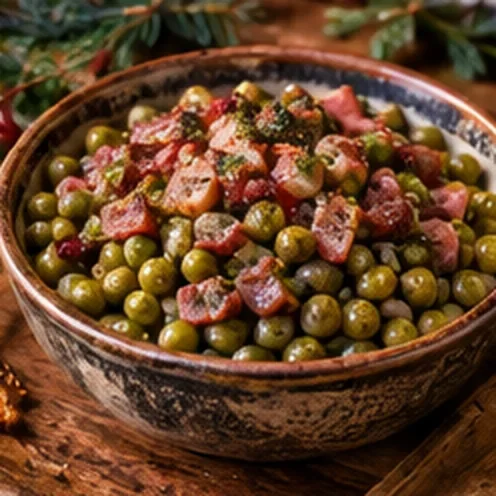
A bowl of Latvian grey peas with crispy smoked bacon and fried onion, with a glass of kefir
Estimate: ~470 kcal per serving (4 servings)

Pelēkie Zirņi ar Speķi: Latvian Grey Peas with Bacon

  • Prep15 min
  • Cook1 h 15 min + overnight soak
  • Makes4 servings
  • Door24 December

1. Soak the peas: The night before, rinse the grey peas and cover them with plenty of cold water. Leave to soak overnight.
2. Boil the peas: Drain, cover with fresh water and simmer for about 1 hour, until soft but not mushy. Add salt only at the end, then drain.
3. Crisp the bacon: Cut the smoked bacon into small cubes and fry it in a dry pan for 8 minutes, until the fat runs and the pieces are crisp.
4. Fry the onion: Add the chopped onion to the bacon fat and fry for 7 minutes, until golden.
5. Mix: Stir the peas into the bacon and onion and warm through for 3 minutes, adding black pepper.
6. Serve: Serve hot with a glass of cold kefir or sour milk, as Latvians do.

Peas so you won't cry next year

History & Origins

Grey peas, a large dark pea grown in the Baltics, are the most Latvian dish of all and a must on the Christmas Eve table, together with pork, sauerkraut and gingerbread. In Latvia, Ziemassvētki (Christmas) mixes Christian feast and ancient winter-solstice customs, from dragging a log around the village to burning it, to mummers in masks.

The folk belief is that you must eat all your peas on Christmas Eve: every pea left on the plate means a tear in the coming year. Another custom says that the more peas you eat, the more money you will have. Either way, finish your bowl.

More recipes from history are in Taste Lab all year round.Open Taste Lab